If your Roblox Tycoon 142 game runs slowly, crashes during peak play, or feels unresponsive when players build or upgrade script optimization tools are likely what you need. These aren’t magic fixes, but practical utilities that help clean up inefficient code, reduce memory leaks, and cut down on unnecessary server-client communication in Tycoon 142 projects.
What does “Roblox Tycoon 142 script optimization tools” actually mean?
It refers to scripts, plugins, or built-in Roblox Studio features designed specifically for improving how Tycoon 142 games execute logic especially around resource generation, player progression tracking, shop interactions, and real-time stat updates. Unlike general Roblox optimization guides, these tools account for Tycoon 142’s common patterns: heavy use of BindAction, frequent RemoteEvent/RemoteFunction calls between client and server, and loops that check inventory or production rates every frame.
When do developers reach for these tools?
You’ll typically use them after noticing lag spikes when more than 10–15 players join, or when the game starts dropping frames during upgrades or bulk purchases. One developer reported their Tycoon 142 shop script was calling GetPropertyChangedSignal("Value") on 200+ NumberValues every 0.03 seconds causing consistent 60ms server delays. A targeted script optimization tool helped replace those with a single debounced update handler. That kind of issue is common and fixable without rewriting everything from scratch.
What’s a realistic example of using one?
Say your Tycoon 142 uses a loop like this on the server:
- Every 0.1 seconds, scan all player-owned factories
- For each factory, check if it’s producing, then add resources to inventory
- Then broadcast updated stats to every client
That works fine with 3 players but at 30 players with 5 factories each, it’s doing 450 checks per tenth of a second. An optimization tool might help you batch those updates, throttle broadcasts, or move non-critical logic to the client safely. You can see how this fits into broader tycoon development tools that support iterative tuning not just one-off fixes.
What mistakes do people make with these tools?
- Running optimization tools before profiling: jumping straight to “minify scripts” or “auto-debounce everything” without first checking where time is spent (use Roblox Studio’s Performance tab)
- Treating client-side and server-side logic the same: some optimizations that speed up local UI won’t help server load and may even hurt it
- Over-optimizing early: replacing a simple
forloop with a complex coroutine system before confirming it’s the bottleneck - Ignoring asset dependencies: a script may run fast, but if it triggers repeated
AssetService:LoadAsset()calls for icons or sounds, performance still suffers
That last point ties directly into how assets behave in Tycoon 142 builds so it’s worth cross-checking with an asset pipeline validator before assuming the script is the only problem.
How do you pick the right tool for your project?
Start by asking: Is this a solo project or team-based? If you’re collaborating, tools that integrate with version control and offer shared linting rules like those found in the collaborative development workspace help avoid inconsistent optimizations across team members. For solo devs, lightweight plugins that highlight expensive functions or suggest safer alternatives (e.g., swapping Players:GetPlayers() for Players.PlayerAdded + cached references) tend to be more practical.
Also consider how much control you need. Some tools auto-rewrite scripts handy for quick wins, but risky if you rely on specific timing or order of operations. Others give reports and suggestions, letting you decide what to change. Both approaches have trade-offs; there’s no universal “best.”
One widely used external reference is the Roblox Lua Standard library, which includes utility functions for safe, efficient iteration and state management common needs in Tycoon 142 scripting.
What should you do next?
Open your Tycoon 142 game in Roblox Studio, go to the Performance tab, and record a 10-second session with 5–10 players active (or simulate load using Test Live). Look for functions with high “Self Time” under ServerScriptService or ReplicatedStorage. Then:
- If most time is spent in loops over player data: try batching or caching
- If RemoteEvents dominate: check if you’re firing too often or sending redundant data
- If memory usage climbs steadily: look for uncleaned connections (e.g., BindAction without UnbindAction)
Once you’ve identified one clear bottleneck, apply a targeted fix and test again. Small, measured changes usually work better than sweeping rewrites.
 Roblox Tycoon 142 Asset Pipeline Validator
 Roblox Tycoon 142 Collaborative Development Workspace
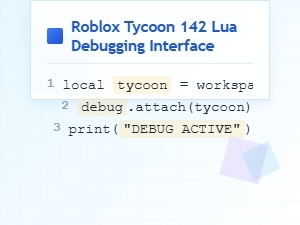 Roblox Tycoon 142 Lua Debugging Interface
 Roblox Tycoon 142 Performance Profiler Dashboard
 How Roblox Tycoon 142 Premium Pricing Shapes Player Behavior
 Roblox Tycoon Passive Income Strategies